Reinventing the Audio Visualizer: The Atomic Sprocket
I've been working on a new audio visualizer I'm calling the atomic sprocket. I wanted to artistically reinvent what music looks like and move away from the vertical bars of the traditional audio visualizers. It's still a work in progress, and the following two videos show the atomic sprocket visualizing Radiohead's Reckoner and Sufjan Steven's Sister Winter. I'd appreciate feedback, so please leave a comment.


Return on Involvement - The Rainforest
I've been reading The Rainforest over the past few weeks. I recently came across a concept called ROI: not return on investment, but return on involvement. Huang and Horowitt, the authors of the book, have observed that "people in rainforests are motivated for reasons that defy traditional economic notions of 'rational' behavior." Learning that the different actors in a booming startup ecosystem, what Huang and Horowitt call a rainforest, behave with motivations that defy rational economic theories of human behavior answered a major problem I've been struggling to answer in my thesis. The underlying problem is a problem about mentor motivations. Since my thesis is about mentors and entrepreneurs identifying each other, a part of the problem is what motivates mentors to provide free advice and even meet with an entrepreneur in the first place?
I think the return on involvement describes the behavior of various actors I've also observed in Philadelphia's startup ecosystem. Huang and Horowitt show that the denizens of a startup ecosystem help startups because they "seek a return on involvement from participating in and contributing to the success of innovative ventures."
As it applies to my thesis, this means that mentors are motivated to provide advice to an entrepreneur for a later return on involvement in the venture.
To learn more about my thesis, check out the Table of Contents.
I think the return on involvement describes the behavior of various actors I've also observed in Philadelphia's startup ecosystem. Huang and Horowitt show that the denizens of a startup ecosystem help startups because they "seek a return on involvement from participating in and contributing to the success of innovative ventures."
As it applies to my thesis, this means that mentors are motivated to provide advice to an entrepreneur for a later return on involvement in the venture.
To learn more about my thesis, check out the Table of Contents.
The Badge, Iteration 2
In a previous blog post, I wrote about and showed some examples of the first iteration of the Badge. A name tag that helps the right entrepreneurs and mentors to identify each other. I've been working on a second iteration that I also printed out on 3.3" x 4" labels. In this version of the name tag, I'm experimenting with using color to afford easy communication of information. For example, color coding could allow for differentiation between a mentor or an entrepreneur, or it could convey whether their expertise is in product development, customer development, team development, or business modeling. At the moment, I've used color to signify whether the user is a mentor or an entrepreneur.


You can see the first iteration and relevant information to it here.
Back to Table of Contents.


You can see the first iteration and relevant information to it here.
Back to Table of Contents.
Analysis of First Round of Interviews
After finishing my first round of interviews, I came back to the studio and placed a single quote and observation per card. I spread them out to see all the cards at the same time. I began grouping the different data points and slowly, a pattern emerged. The following few images show the process I went through to make sense of the interviews I conducted.


I learned there are three major concerns entrepreneurs seem to have: traction, mentors, and funding. I discovered that when startups want funding from investors, usually, they had to prove they had some sort of traction, and a mentor sometimes proved to be a point of traction early on.
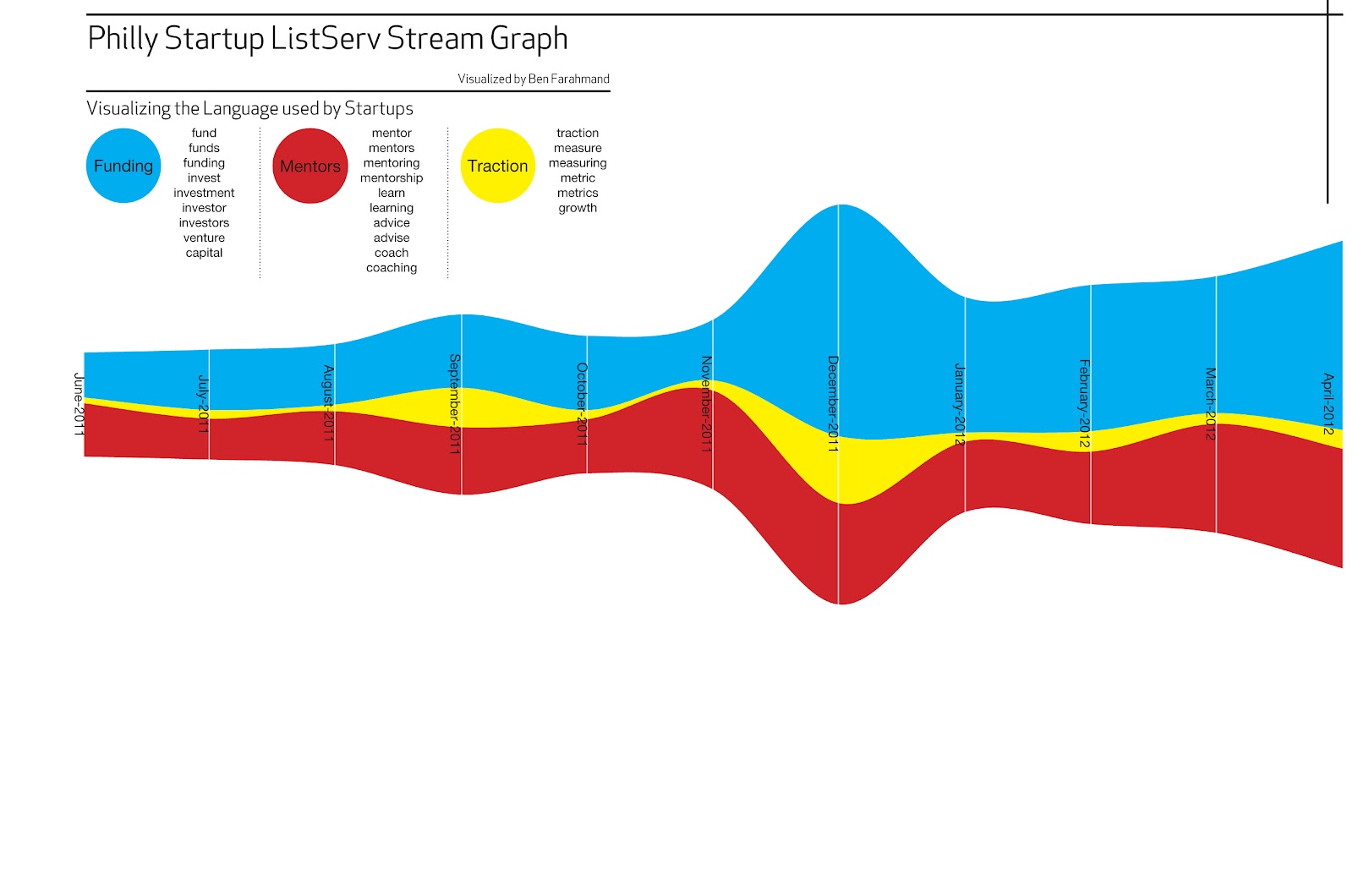
Mentors lend their credibility to the discovery stage startup, and thus, act as a point of traction. By lending their credibility, it reassures investors that their funds are in safe hands. In turn, funding allows the startup to set up more experiments to test how well their product or service fits in the market. Essentially, it becomes a cycle. In some cases, some amount of traction is needed to get the attention of the mentor, which then permits funds to be raised in order to propel the business even further than before.
 I had learned the importance of mentors as a key starting point to the discovery stage startup, and I had chosen to focus on them at this point in my process. However, I needed a larger perspective on how mentors are attained, who they are, where they are, and their level of influence within the ecosystem. This new knowledge about traction, mentors, and funding informed my next step to map the different perspectives I had acquired and create the tangible interview.
Back to Table of Contents.
First Round of Interviews: David

At the moment, he’s concerned with how to track metrics and what types of metrics to track because he thinks a lot about how to set up an experiment such that the outcome can be measured for their website. Regarding Inhabi, he wants to understand two major things: the cost of acquisition of a new customers, and the lifetime value of that customer.
Inhabi has been having traction and has had a few customers. However, he’s trying to figure out how to replicate this success by pin-pointing the variable that allowed for the customers to use Inhabi’s service. He thinks setting up the right type of experiment and knowing what to measure will reveal why these early customers used their service.
When asked about the role of the designer and when a designer should become involved, he believes the designer should get involved on behalf of the venture capitalist, act as an intermediary between the startup and the venture capitalist, and ensure the startup has an effective user experience.
Back to First Round of Interviews.
Back to Table of Contents.
First Round of Interviews: Jake

From the time he’s spent at Good Company Ventures and being involved with social impact internet startups, he’s realized that it’s very challenging to figure out how to monetize social impact internet startups. More importantly, he has noticed that investors are less willing to invest in an internet startup that doesn’t know how to monetize its service or product.
In a discussion about when designers should be involved with a startup, Jake thinks that designers should be involved from the beginning, but he also thinks that a single person doesn’t have enough time and money to afford a designer. Instyead, he believes that more designers should be starting businesses.
First Round of Interviews: Todd

When he first started his business, he had between ten to fifteen different value propositions, and it took him about three months to narrow it down to three specific areas: allowing the users of his service to retain as much profit while selling through the site, allowing users to sell as much as they can, allowing users to be able to reach an audience they wouldn’t normally reach.
Back to First Round of Interviews.
Back to Table of Contents.
First Round of Interviews: Jonny

Currently, he’s working with an incubator, Alphalab. He believes he could be helpful earlier in a startups life, but Alphalab said he should come in a few weeks before demo-day, the day that they pitch to investors and aid the startup in visually enhancing their pitches. When working in this context, his allegiance is to the startup as opposed to the venture capitalist (VC).
He’s turning his visual thinking service into a consulting business and wants to create an illustrated guide to starting a business. He knows there’s a large market in creating visual animations and thinks he can reach out to a niche market with his visual thinking service. On one plane ride, he was talking to an experienced entrepreneur, visualizing what he does, and the experienced entrepreneur said he can be hired by VCs to help their companies because it’s good for the VCs if their companies succeed. He’s interested in what and how VC’s think, but he hasn’t worked directly with them yet.
He has observed that most startups aren’t really going and understanding the value they’re bringing their customer, so he helps them build metaphors for effective communication.
He likes to work with start-ups because he gets to meet everyone, “it’s exciting, they’re real people, they’re probably going to fail, but I can probably help them, even if a little.”
Back to First Round of Interviews.
Back to Table of Contents.
Subscribe to:
Posts (Atom)